
Information on Critical and Energy Minerals

NDOM Open Data Website: Nevada Mineral Producers, Commodities & Occurrences
The purpose of this page is to present current active mines and production data for the State of Nevada. This page is also intended to give the user the ability to see where mineral commodities and occurrences have been documented in the state of Nevada with respect to current mineral and producers in the State.
Users can filter historic mining districts by commodity type, including critical minerals, and follow weblinks to additional information and resources.
Hosted by the Nevada Division of Minerals.
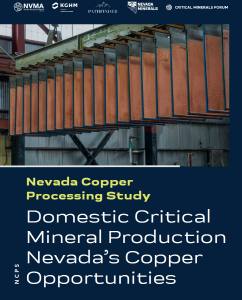
Nevada Copper Processing Study: Domestic Critical Mineral Production, Nevada's Copper Opportunities (2025)
The Nevada Mining Association and the Nevada Division of Minerals commissioned Convergent Mining, LLC to conduct a study focused on copper processing in Nevada. The purpose of the study was to identify existing and potential copper resources and to evaluate both current and prospective processing infrastructure. This analysis was conducted within the broader objective of supporting the development of a closed-loop domestic supply chain for refined copper in the United States (U.S.), while assessing the opportunities and challenges associated with resource development and processing capacity in the state.
The study found that copper resources in Nevada are geologically and geographically limited to specific copper producing districts. Given these constraints and the current and projected scale of production, available orebodies are unlikely to support a centralized copper processing facility without sourcing additional concentrate from nearby western states, such as Arizona, which both processes concentrate internally and exports large volumes for processing abroad. While regional infrastructure exists, most processing facilities, whether active or inactive, are tied to individual mining projects. Full cycle copper processing capacity in the U.S. remains limited, with only two operating smelters. As a result, between 300 and 400 Kt of copper in concentrate is exported, and new mine operations lack domestic options for processing sulfide ore concentrate.

USGS National Minerals Information Center Website
Statistics and information on the worldwide supply of, demand for, and flow of minerals and materials essential to the U.S. economy, national security, and protection of the environment.
DOI-USGS 2025 List of Critical Minerals
The U.S. Geological Survey developed the draft 2025 List using updated methods to assess how disruptions in mineral supply could affect the U.S. economy and national security. The final List adds 10 new minerals—boron, copper, lead, metallurgical coal, phosphate, potash, rhenium, silicon, silver, and uranium—based on new data, public feedback and interagency recommendations.
The 2025 List marks the third list since the effort began under a 2017 Executive Order (EO 13817) by President Trump directing federal agencies to strengthen mineral security. The Energy Act of 2020 signed by President Trump requires the list to be reviewed at least every three years to reflect new data and changing supply conditions. Accordingly, the list is not static; it is intended to be dynamic and will be updated at least every two years to reflect evolving circumstances.
The 2025 List highlights the importance of rare earth elements, a subset of critical minerals whose supply disruption would impose the highest cost on the U.S. economy, which are essential to technologies like smartphones, hard drives, and advanced defense systems. In 2024, the U.S. imported 80% of the rare earth elements it used. This year, the Trump administration has taken decisive steps to bolster our supply chains: investing in U.S. production and securing access through partners in Australia, Japan, Malaysia, and Thailand. Meanwhile, the USGS is mapping new domestic deposits and advancing the science to better understand how geology influences their quality, size, and viability for extraction.

DOE Critical Minerals and Materials Website
The Advanced Materials & Manufacturing Technologies Office's (AMMTO) Critical Minerals and Materials portfolio addresses high-impact opportunities and challenges across the entire life cycle of high priority critical minerals and materials for energy technologies.

IEA Global Critical Minerals Outlook 2025
Critical minerals, which are essential for a range of energy technologies and for the broader economy, have become a major focus in global policy and trade discussions. Price volatility, supply chain bottlenecks and geopolitical concerns make the regular monitoring of their supply and demand extremely vital.
The Global Critical Minerals Outlook 2025 includes a detailed assessment of the latest market and investment trends, along with their implications for critical minerals security. As in last year’s Outlook, it provides a snapshot of recent industry developments from 2024 and early 2025 and offers medium- and long-term projections for the supply and demand of key energy minerals, taking into account the latest policy and technology developments.
The 2025 Outlook also explores key techno-economic issues such as policy mechanisms to support diversification; mineral supply chains for emerging battery technologies; recent innovations in mining, refining and recycling; and a broader view on strategic minerals for applications beyond the energy sector. As a new chapter, the report also includes a comprehensive review of mineral markets and policy developments in different regions. The report will be accompanied by an updated version of our Critical Minerals Data Explorer, an interactive online tool that allows users to explore the latest IEA projections.

Article: EIA / Energy Minerals Observatory: The data deficits in critical supply chains (Dec., 2025)
Critical minerals, such as copper, cobalt, and silicon, are vital for energy technologies, but most critical minerals markets are less transparent than mature energy markets, such as crude oil or coal. Like other energy markets, many supply-side and demand-side factors influence pricing for these energy-relevant critical minerals, but critical minerals supply chains contain numerous data gaps.
The lack of transparency in both supply and demand data compounds throughout the supply chains of energy-relevant critical minerals, muting price discovery and complicating in-depth analysis and forecasting.
Here we discuss some of the key factors driving energy-relevant critical mineral pricing and how these factors influence analysis of markets and supply chains. The degree to which these factors apply to each energy-relevant critical mineral varies.
U.S. Department of Energy Critical Minerals Assessment (July, 2023)
For more than a decade, the U.S. Department of Energy (DOE) has funded basic and applied research and development (R&D) related to critical materials to address the scientific and technological (S&T) challenges that underpin supply chain vulnerabilities. These investments were made possible through the first DOE Critical Materials Strategy in 2010. This included the first DOE Critical Materials Assessment – identifying which materials were critical for clean energy technologies. It also defined the pillars that form the foundation of the DOE research strategy that guided these investments.
The Energy Act of 2020 expanded DOE authorities to address critical materials challenges through a Critical Materials Research, Development, Demonstration, and Commercialization Application (RDD&CA) Program. The Critical Materials RDD&CA Program allows DOE to invest across the entire research continuum and supply chain.
U.S. Department of Energy, July 2023.
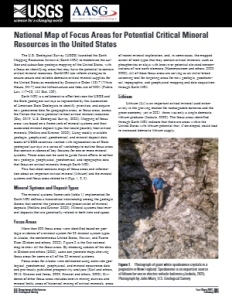
National Map of Focus Areas for Potential Critical Mineral Resources in the United States (Feb. 2023)
The U.S. Geological Survey (USGS) launched the Earth Mapping Resources Initiative (Earth MRI) to modernize the surface and subsurface geologic mapping of the United States, with a focus on identifying areas that may have the potential to contain critical mineral resources.
U.S. Geological Survey, Feb. 2023.
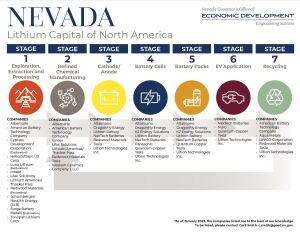
Nevada Lithium Chain
Nevada is the only U.S. state that encompasses every facet of the lithium-ion battery economy and life cycle, from the exploration and mining of natural Lithium deposits to the research and development to production and assembly, and finally the recycling operations.
Nevada Governor's Office of Economic Development Publication, Jan. 2023.
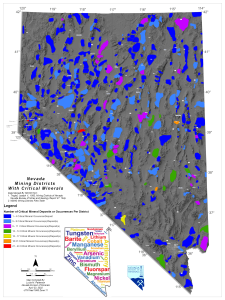
Nevada Mining Districts with Historical Critical Mineral Production
2022 map showing critical mineral occurrences within Nevada's historic mining districts.
Map created by the Nevada Division of Minerals.
Nevada Mineral Explorer Web App
This web application was developed as a tool for explorationists to identify and discover mineral resources throughout Nevada. Data in this web application are organized by category (upper right-hand side of map). Each category is indicated with a different symbol, which are outlined below.
Hosted by the Nevada Bureau of Mines and Geology.
U.S. Geological Survey Mineral Resources Online Spatial Data Web Application
Interactive maps and downloadable data for regional and global Geology, Geochemistry, Geophysics, and Mineral Resources. Includes datasets for critical minerals.
U.S. Executive Order on America’s Supply Chains
Link to the White House presidential actions webpage, Executive Order on America’s Supply Chains.
U.S. Final List of Critical Minerals (2022)
By this notice, the Secretary of the Interior, acting through the Director of the U.S. Geological Survey (USGS), presents the 2022 final list of critical minerals and the methodology used to develop the list. The 2022 final list of critical minerals.